
Complete Guide To AI Business Process Automation Benefits: Transform Your Enterprise In 2026

Introduction: The AI Automation Revolution Transforming Business
Artificial Intelligence is no longer a futuristic concept—it’s the driving force behind the most successful businesses in 2026.
AI business process automation benefits extend far beyond simple task completion, fundamentally reshaping how organizations operate, compete, and grow. With McKinsey projecting up to $4.4 trillion in global economic value from generative AI alone, and 92% of companies planning increased AI investments by 2028, the question is no longer whether to adopt AI automation—but how quickly you can implement it.
This comprehensive guide explores the transformative power of AI business process automation, from measurable ROI and efficiency gains to implementation strategies that deliver results.
Whether you’re a small business owner exploring automation for the first time or an enterprise leader scaling AI across departments, you’ll discover actionable insights backed by real-world case studies and expert research.

Understanding AI Business Process Automation
AI business process automation (BPA) represents the convergence of artificial intelligence technologies—including machine learning, natural language processing, and computer vision—with traditional automation systems. Unlike conventional automation that follows rigid, rule-based workflows, AI-powered automation learns, adapts, and makes intelligent decisions based on data patterns and contextual understanding.
What Makes AI Automation Different?
Traditional automation excels at repetitive, predictable tasks with clear rules. AI automation, however, handles complexity and ambiguity. It can process unstructured data like emails and documents, understand context and intent, learn from patterns to improve over time, and make decisions based on multiple variables. This fundamental difference enables AI to automate processes that previously required human judgment and expertise.
Key Components of AI Automation
Modern AI automation systems integrate several core technologies:
- Machine Learning (ML): Enables systems to learn from data and improve performance without explicit programming, powering predictive analytics and pattern recognition
- Natural Language Processing (NLP): Allows AI to understand, interpret, and generate human language for document processing, customer interactions, and sentiment analysis
- Computer Vision: Empowers AI to analyze visual information for quality control, inventory management, security monitoring, and defect detection
- Robotic Process Automation (RPA): Automates repetitive, rule-based tasks across multiple applications, often serving as the execution layer for AI decisions
- Predictive Analytics: Uses historical data to forecast trends, demand, equipment failures, and potential issues before they occur
- Intelligent Document Processing: Extracts, classifies, and processes information from documents automatically, handling invoices, contracts, and forms
Proven AI Business Process Automation Benefits
1. Dramatic Productivity and Efficiency Gains
AI automation accelerates workflows by handling high-volume tasks that would take humans hours or days to complete. Research shows AI could automate up to three hours of daily work, with companies reporting 40-50% efficiency improvements across various sectors.
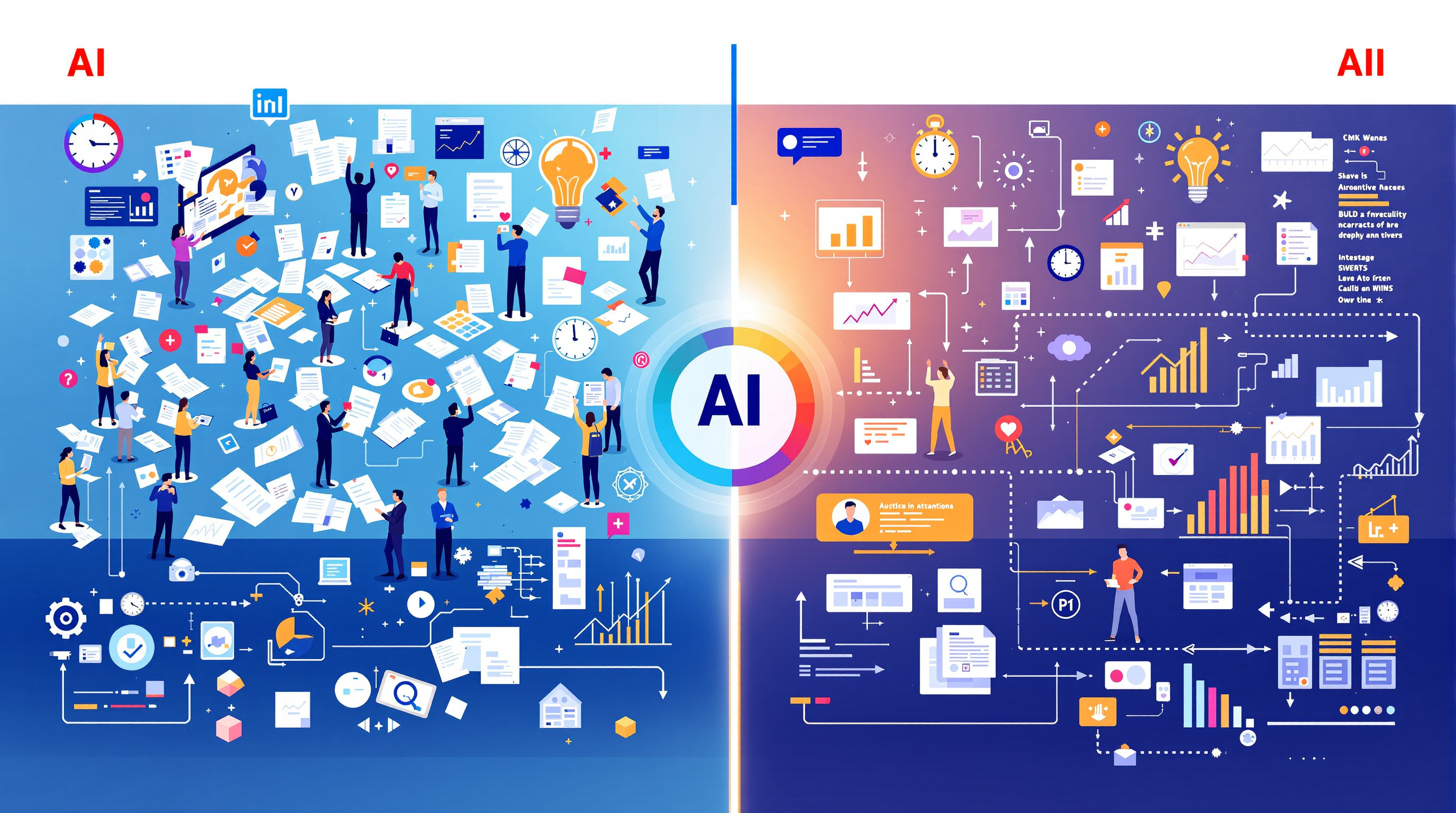
The productivity gains stem from AI’s ability to work continuously without fatigue, process information at superhuman speeds, and handle multiple tasks simultaneously. Where a human analyst might review 50 documents per day, an AI system can process thousands while maintaining consistent accuracy.
Real-World Impact:
- Amazon’s AI-driven supply chain optimizes inventory and route planning, reducing logistics costs by 5-20% and improving delivery times
- Siemens’ predictive maintenance systems detect equipment faults before failure, cutting unplanned downtime by 35% and extending asset lifespan
- Downer’s process automation saved over 3,350 hours by automating 23 business processes, freeing employees for strategic initiatives
- Eightfold’s AI recruitment platform decreased time-to-hire by 40% while improving candidate quality and diversity
2. Substantial Cost Savings and ROI
The financial benefits of AI business process automation are compelling and measurable. Organizations implementing AI automation report cost reductions ranging from 20-50% across different operational areas, with ROI often exceeding 200-900% within the first 18 months.

Cost savings come from multiple sources: reduced labor costs for repetitive tasks, fewer errors requiring correction, lower operational overhead, decreased compliance violations and penalties, and optimized resource utilization. The cumulative effect can transform a company’s bottom line.
Documented Cost Savings:
- American Express: AI fraud detection saves approximately $2 billion annually by identifying suspicious transactions in real-time
- JPMorgan Chase: AI platform automates legal document reviews, reducing 360,000 hours of manual work yearly—equivalent to 180 full-time employees
- Pfizer: Automated quality control reduced production errors by 95%, saving millions in waste and recalls
- UPS: Route optimization saves 100 million miles and 10 million gallons of fuel annually, translating to $300-400 million in cost savings
- Walmart: AI inventory management reduced excess stock by 35%, freeing up capital and warehouse space
- Sparex: AI business intelligence implementation saved $5 million annually through improved inventory accuracy and faster order processing
According to Deloitte’s projections, AI-driven automation delivers 20-30% cost reductions by eliminating labor-intensive tasks and minimizing errors.
3. Enhanced Risk Management and Compliance
AI automation strengthens risk management by maintaining precision in transactions and enforcing consistent logic, reducing errors from human fatigue. AI systems can detect fraud, policy violations, and compliance issues in real-time through advanced pattern recognition and anomaly detection.
The compliance benefits are particularly valuable in heavily regulated industries like finance, healthcare, and manufacturing. AI systems maintain perfect audit trails, ensure consistent policy application, and flag potential violations before they become costly problems.
Risk Reduction Examples:
- Visa’s AI fraud detection prevented $40 billion in losses annually while reducing false positives by 60%, improving customer experience
- Healthcare AI systems automate patient data compliance, reducing HIPAA breaches by 80% and ensuring proper documentation
- KPMG’s AI deployment achieved 65% adoption in financial reporting for mismatch identification, catching errors before they reach regulators
- Darktrace’s Antigena neutralized 92% of cybersecurity threats autonomously, reducing breach costs and analyst workload
- Manufacturing AI ensures consistent quality control, reducing defect rates by 40% and preventing costly recalls
4. Superior Customer and Employee Experience
AI automation elevates both customer satisfaction and employee engagement by handling routine inquiries and freeing staff for meaningful work. This dual benefit creates a virtuous cycle: happier employees provide better service, leading to more satisfied customers.

Customer Experience Improvements:
- Bank of America’s Erica: Managed over 1.5 billion interactions, reducing call center load by 17% while providing instant, accurate responses 24/7
- H&M’s virtual assistant: Resolved 70% of queries autonomously, increasing conversion rates by 25% and reducing response times by 66%
- AI chatbots: Handle customer queries with 93% accuracy, providing 24/7 availability and personalized recommendations
- Singapore’s “Ask Jamie”: Reduced call-center volume by 50% and improved response times by 80%, enhancing citizen satisfaction
- ADT’s AI support: Increased customer satisfaction by 30% and conversions from 44% to 61% through faster, more accurate assistance
Employee Benefits:
- 100% of software project managers report better outcomes and reduced burnout with AI tools
- Microsoft saw an 87% increase in employee satisfaction after automating IT help desks
- Mass General Brigham reduced physician documentation time by 60%, increasing patient interaction and care quality
- CirrusMD boosted physician productivity by 234% through AI-powered documentation and benefits navigation
- Employees freed from repetitive tasks report higher job satisfaction and engagement in strategic work
5. Scalability and Innovation Acceleration
AI enables businesses to scale operations without proportional resource increases, fostering rapid innovation and market adaptation. This scalability is crucial in today’s fast-paced business environment where agility determines competitive advantage.
AI systems handle increased workloads seamlessly, adapting to demand fluctuations without requiring additional staff or infrastructure. This flexibility allows businesses to pursue growth opportunities confidently, knowing their operations can scale efficiently.
Scalability Success Stories:
- Netflix: Saves nearly $1 billion annually through AI-powered recommendation systems that adapt in real-time to user preferences
- Shopify: Scales e-commerce operations for millions of merchants using AI-driven automation, handling peak loads effortlessly
- DHL: Improved on-time delivery by 30% and saved 20% on fuel costs through AI logistics optimization that scales across global operations
- Starbucks: AI personalization increased ROI by 30% and customer engagement by 15% across thousands of locations
- Amazon: AI recommendation engine contributes to 35% of total sales, demonstrating scalable revenue growth
Strategic Implementation: Best Practices for AI Automation Success
Phase 1: Assessment and Planning
Successful AI automation begins with thorough assessment and strategic planning. Rushing into implementation without proper groundwork leads to wasted resources and failed projects. Take time to understand your current state and define clear objectives.
- Identify High-Impact Processes: Evaluate workflows based on volume, error rates, strategic importance, and automation potential. Focus on processes that are repetitive, rule-based, high-volume, error-prone, or time-consuming.
- Define Clear Objectives: Establish measurable goals tied to business outcomes such as cost reduction targets, efficiency improvement percentages, error rate reductions, customer satisfaction improvements, or revenue growth projections.
- Assess Data Readiness: Ensure data quality, accessibility, and compliance with privacy regulations. AI systems are only as good as the data they learn from—invest in data cleansing and governance.
- Evaluate Technical Infrastructure: Determine compatibility with existing systems, integration requirements, cloud vs. on-premise considerations, and security requirements.
- Build Business Case: Calculate expected ROI, identify quick wins for momentum, and secure executive sponsorship for long-term success.
Phase 2: Pilot Implementation
Start with low-risk, high-impact pilot projects to validate assumptions and demonstrate value. Pilots provide valuable learning opportunities and build organizational confidence in AI automation.
- Select Pilot Processes: Choose processes with clear success metrics, manageable scope, willing stakeholders, and potential for quick wins.
- Build Cross-Functional Teams: Include IT specialists, process owners, business stakeholders, and end users to ensure comprehensive perspectives.
- Implement Monitoring Systems: Track performance metrics in real-time, gather user feedback continuously, identify bottlenecks early, and document lessons learned.
- Iterate and Refine: Use pilot insights to optimize AI models, adjust workflows based on feedback, and address technical issues before scaling.
Example: A financial services company piloted AI-powered loan processing, reducing review times from three days to 15 minutes while improving accuracy by 30%. This success built momentum for expanding AI automation to other lending processes.
Phase 3: Scaling and Optimization
After successful pilots, scale AI automation across the organization systematically. Scaling requires careful planning to maintain quality and manage change effectively.
- Develop Governance Frameworks: Establish policies for AI ethics, data privacy and security, model validation and monitoring, and compliance requirements.
- Invest in Change Management: Provide comprehensive training programs, address employee concerns proactively, communicate benefits clearly, and celebrate early wins.
- Implement Continuous Improvement: Use feedback loops to refine AI models, monitor performance metrics continuously, update models with new data, and optimize workflows based on results.
- Measure and Communicate ROI: Track efficiency gains and cost savings, document business impact, share success stories, and justify continued investment.
- Expand Strategically: Prioritize high-value processes, maintain quality standards, ensure adequate resources, and avoid overextension.
Overcoming Common AI Automation Challenges
Challenge 1: Data Quality and Availability
Poor data quality is the most common reason AI automation projects fail. Biased, incomplete, or inaccurate data leads to flawed AI decisions and erodes trust in automation.
Solution: Implement robust data governance processes, including data cleansing and validation, normalization and standardization, regular quality audits, and diverse dataset collection. Use sandbox environments to test data quality before production deployment. Invest in data infrastructure that supports AI requirements.
Challenge 2: Integration with Legacy Systems
Many organizations struggle to integrate AI automation with outdated IT infrastructure, leading to delays, increased costs, and workflow disruptions.
Solution: Adopt modular, API-friendly platforms that facilitate smooth integration. Use phased implementation strategies to minimize disruptions, middleware solutions to bridge legacy systems, and cloud-based AI services for flexibility. Consider gradual infrastructure modernization alongside AI adoption.
Challenge 3: Skill Gaps and Workforce Resistance
Lack of AI expertise and employee fear of job displacement create significant barriers to successful automation adoption.
Solution: Develop comprehensive training programs covering AI fundamentals, tool-specific training, and change management. Emphasize AI as augmentation rather than replacement, involve employees in AI projects early, provide clear career development paths, and celebrate employees who embrace automation.
Challenge 4: Security and Compliance Concerns
AI systems handling sensitive data raise legitimate concerns about security breaches, regulatory compliance, and data privacy.
Solution: Implement encryption and access controls, conduct regular security audits, ensure compliance with GDPR, HIPAA, and other regulations, maintain comprehensive audit trails, and use AI-specific threat detection. Build security into AI systems from the start rather than adding it later.
Challenge 5: Managing Implementation Costs
High upfront costs and uncertain ROI make executives hesitant to invest in AI automation, especially for smaller organizations.
Solution: Conduct thorough cost-benefit analyses, adopt phased rollouts to spread costs, focus on high-impact areas first to justify investments, consider cloud-based solutions for lower upfront costs, and measure ROI continuously to demonstrate value.
Challenge 6: Unrealistic Expectations
Overhyping AI capabilities leads to disappointment and project abandonment when results don’t match inflated expectations.
Solution: Set realistic goals based on industry benchmarks, communicate AI limitations clearly, start with achievable objectives, celebrate incremental progress, and educate stakeholders on AI capabilities and constraints.
Industry-Specific AI Automation Applications
Financial Services
- Fraud Detection: Real-time transaction monitoring and anomaly detection preventing billions in losses
- Document Processing: Automated loan applications, compliance reporting, and contract analysis
- Customer Service: AI-powered chatbots for account inquiries, financial advice, and transaction support
- Risk Assessment: Credit scoring, portfolio optimization, and market risk analysis
- Regulatory Compliance: Automated reporting, audit trail maintenance, and policy enforcement
Healthcare
- Clinical Documentation: Automated patient record updates, medical coding, and billing
- Diagnostic Support: AI-assisted image analysis, disease detection, and treatment recommendations
- Drug Discovery: Accelerated research through AI-powered molecular analysis and clinical trial optimization
- Patient Management: Appointment scheduling, medication reminders, and care coordination
- Administrative Automation: Insurance verification, claims processing, and benefits navigation
Manufacturing
- Predictive Maintenance: Equipment monitoring to prevent downtime and extend asset lifespan
- Quality Control: Computer vision for defect detection and process optimization
- Supply Chain Optimization: Demand forecasting, inventory management, and logistics planning
- Production Planning: Resource allocation, scheduling optimization, and capacity planning
- Safety Monitoring: Hazard detection, compliance tracking, and incident prevention
Retail and E-commerce
- Personalized Recommendations: AI-driven product suggestions increasing conversion rates
- Inventory Management: Automated stock optimization, replenishment, and demand forecasting
- Customer Support: 24/7 AI chatbots for order tracking, returns, and product inquiries
- Dynamic Pricing: Real-time price optimization based on demand, competition, and inventory
- Marketing Automation: Personalized campaigns, customer segmentation, and engagement optimization
Human Resources
- Recruitment: Resume screening, candidate matching, and interview scheduling
- Onboarding: Automated documentation, training coordination, and compliance tracking
- Performance Management: Data-driven evaluations, feedback analysis, and development planning
- Employee Engagement: Sentiment analysis, retention prediction, and satisfaction monitoring
- Benefits Administration: Enrollment automation, claims processing, and policy management
Measuring AI Automation ROI
Establishing clear metrics is essential for demonstrating AI automation value and justifying continued investment. Without proper measurement, it’s impossible to optimize performance or prove business impact.
Key Performance Indicators (KPIs)
- Efficiency Metrics: Process completion time reduction, throughput increase, resource utilization improvement, and task automation percentage
- Cost Metrics: Operational cost reduction, labor savings, error-related cost avoidance, and total cost of ownership
- Quality Metrics: Accuracy rate improvement, error reduction percentage, compliance adherence, and defect rate decrease
- Customer Metrics: Satisfaction score improvement, response time reduction, resolution rate increase, and Net Promoter Score (NPS) change
- Employee Metrics: Productivity gains, job satisfaction improvement, retention rate increase, and time saved for strategic work
- Business Impact Metrics: Revenue growth, market share increase, competitive advantage, and innovation acceleration
ROI Calculation Framework
Calculate ROI by comparing total benefits (cost savings, revenue increases, efficiency gains) against total costs (implementation, maintenance, training):
ROI = (Total Benefits – Total Costs) / Total Costs × 100
Total Benefits Include:
- Direct cost savings from reduced labor and operational expenses
- Revenue increases from improved customer experience and faster processes
- Risk mitigation value from reduced errors and compliance violations
- Productivity gains from employee time savings
- Competitive advantages from faster innovation and market response
Total Costs Include:
- Technology acquisition and licensing fees
- Implementation and integration costs
- Training and change management expenses
- Ongoing maintenance and support
- Infrastructure upgrades and data preparation
Case studies show AI automation ROI ranging from 200-900%, with most organizations achieving positive ROI within 12-18 months. Financial services and manufacturing typically see faster returns, while healthcare and government may require longer timeframes due to regulatory complexity.
Future Trends in AI Business Automation
1. Agentic AI and Autonomous Systems
By 2028, 33% of enterprise software applications will incorporate agentic AI, enabling up to 15% of daily work decisions to be made autonomously. These intelligent agents will handle complex, multi-step tasks with minimal human intervention, learning from experience and adapting to changing conditions.

Agentic AI represents a fundamental shift from tools that assist humans to systems that act independently within defined parameters. Examples include AI agents that negotiate contracts, manage supply chains end-to-end, and orchestrate complex marketing campaigns autonomously.
2. Hyperautomation
90% of large enterprises are expected to prioritize hyperautomation—the end-to-end automation of entire business processes using AI, ML, and RPA. This trend will enable organizations to automate not just individual tasks but complete workflows spanning multiple departments and systems.
Hyperautomation combines multiple technologies to create seamless, intelligent workflows that adapt to exceptions and optimize themselves continuously. It represents the maturation of automation from isolated point solutions to comprehensive business transformation.
3. AI-Powered Analytics and Decision-Making
By 2026, 75% of enterprises will operationalize AI for analytics, driving a fivefold increase in data infrastructure investments. AI will provide real-time insights for strategic decision-making across all business functions, from financial planning to product development.
Advanced AI analytics will move beyond descriptive reporting to predictive and prescriptive insights, recommending specific actions and automatically implementing approved decisions. This evolution transforms data from a historical record to a strategic asset driving proactive business management.
4. Enhanced Security and Governance
91% of security leaders are expected to adopt automated cybersecurity tools by 2026, with AI-driven threat detection and compliance monitoring becoming standard practice. AI security systems will identify and neutralize threats faster than human analysts, adapting to new attack vectors in real-time.
Governance frameworks will evolve to address AI-specific risks, including algorithmic bias, data privacy, and ethical concerns. Organizations will implement AI ethics boards, automated bias detection, and transparent AI decision-making processes.
5. Workforce Transformation
AI automation will create 97 million new jobs while displacing 85 million, emphasizing skills in AI management, data analysis, and human-AI collaboration. Organizations must invest in reskilling programs to prepare their workforce for this transformation.
The future workforce will work alongside AI systems, focusing on tasks requiring creativity, emotional intelligence, complex problem-solving, and strategic thinking. Success will depend on organizations’ ability to help employees transition to these new roles.
6. Low-Code/No-Code AI Platforms
70% of new applications will use low-code or no-code technologies by 2026, democratizing AI automation and enabling business users to create sophisticated workflows without programming expertise. This trend accelerates AI adoption by removing technical barriers.
7. AI-Blockchain Integration
The convergence of AI and blockchain will enable secure, transparent, and auditable automated processes, particularly valuable in supply chain management, financial services, and healthcare where trust and traceability are critical.
Getting Started: Your AI Automation Roadmap
Step 1: Conduct an Automation Readiness Assessment
- Evaluate current processes and identify automation opportunities using process mining tools
- Assess data quality, accessibility, and governance maturity
- Evaluate technical infrastructure and integration capabilities
- Determine budget and resource availability for AI initiatives
- Identify internal champions and build executive sponsorship
Step 2: Build Your AI Strategy
- Define clear business objectives aligned with organizational goals
- Prioritize high-impact, low-risk processes for initial implementation
- Develop a phased rollout plan with clear milestones and success criteria
- Establish governance frameworks for ethics, security, and compliance
- Create a change management plan addressing workforce concerns
Step 3: Select the Right Technology Partners
- Choose AI platforms that integrate seamlessly with existing systems
- Evaluate vendors based on scalability, security, support, and track record
- Consider low-code/no-code solutions for faster deployment and broader adoption
- Assess cloud vs. on-premise options based on security and compliance requirements
- Negotiate contracts with clear SLAs and performance guarantees
Step 4: Implement and Iterate
- Start with pilot projects to validate assumptions and demonstrate value
- Gather feedback continuously from users and stakeholders
- Refine processes based on real-world performance data
- Address technical issues and optimize AI models iteratively
- Document lessons learned and best practices for scaling
Step 5: Measure, Optimize, and Scale
- Track KPIs and calculate ROI regularly using established frameworks
- Optimize AI models based on performance data and changing business needs
- Expand automation to additional processes and departments systematically
- Maintain quality standards and governance as you scale
- Continuously invest in workforce development and change management
Conclusion: Embrace AI Automation for Competitive Advantage
The AI business process automation benefits are clear and compelling: dramatic efficiency gains of 40-50%, substantial cost savings of 20-50%, enhanced risk management preventing billions in losses, and improved customer and employee experiences driving satisfaction and retention. Organizations that embrace AI automation strategically position themselves for sustained competitive advantage in an increasingly digital economy.
Success requires more than just technology adoption—it demands a holistic approach that addresses data quality, change management, security, and continuous optimization. By following proven implementation strategies and learning from real-world case studies, businesses of all sizes can harness AI business automation to transform operations and drive growth.
The evidence is overwhelming: companies implementing AI automation see ROI ranging from 200-900%, with most achieving positive returns within 12-18 months. From Amazon’s supply chain optimization saving millions to Bank of America’s Erica handling billions of interactions, AI automation delivers measurable business value across every industry and function.
The question is no longer whether to adopt AI business process automation, but how quickly you can implement it to stay ahead of the competition. Start with a clear strategy, pilot high-impact processes, and scale systematically. The future of business is automated, intelligent, and adaptive—and that future is now.
Ready to Transform Your Business with AI Automation?
Begin your AI automation journey today by assessing your current processes and identifying opportunities for intelligent automation. Whether you’re looking to reduce costs, improve efficiency, or enhance customer experiences, AI business process automation offers proven solutions backed by measurable results.
The organizations that thrive in 2026 and beyond will be those that embrace AI automation strategically, invest in their workforce, and continuously optimize their intelligent systems. Don’t wait—start your transformation now and unlock the full potential of AI business process automation benefits.
Remember: AI automation is not about replacing humans—it’s about empowering them to focus on what they do best while intelligent systems handle repetitive, data-intensive tasks. The result is a more productive, satisfied workforce delivering exceptional value to customers and stakeholders.